

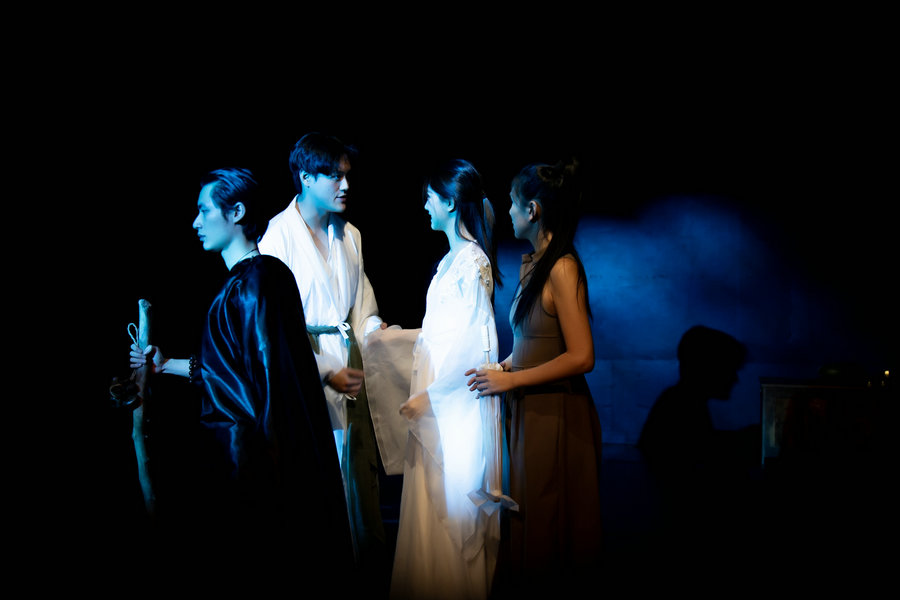
The premiere of Qingbai: Innocence on Dec 1 at Yale University in New Haven, Connecticut, features He Chuning as Bai Suzhen; Tara P. Nyingjè as Xiaoqing; Huang Yuwei, a student at Rhode Island School of Design, as Xu Xian; and Wang Yanhao, a student at Brown University, as Fahai. [Photo provided to chinadaily.com.cn]
The Legend of the White Snake, dating back to China's Tang Dynasty (618–907), is a household folk tale that has been reinterpreted many times over the centuries. It is not only a classic in many local operas, such as Peking and Kunqu, but has also been adapted into numerous films, TV dramas and animated series.
Some of the most popular adaptations include the 1992 costume drama New Legend of Madame White Snake and director Tsui Hark's 1993 film Green Snake, which sheds more light on White Snake's sister-like maidservant, Xiaoqing, a green serpent spirit.
An enchanting blend of romance, tragedy and magic, the tale tells of a poignant love story between Bai Suzhen, a white snake spirit transformed into a woman, and Xu Xian, a handsome scholar. The two are bound by karma and gratitude to one another. Their union, however, is thwarted by a Buddhist monk named Fahai, who deems their relationship transgressive. The story celebrates enduring love, loyalty and the struggle for freedom.
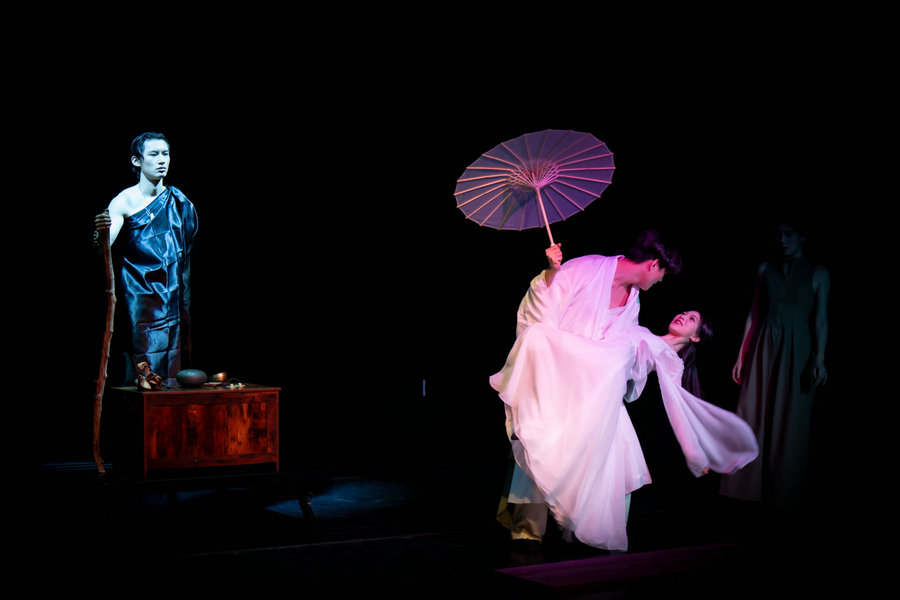
A scene from the premiere of Qingbai: Innocence on Dec 1 at Yale University in New Haven, Connecticut. [Photo provided to chinadaily.com.cn]
Captivated by the legend's lasting allure, He Chuning, also known as Ophelia He, a 21-year-old Chinese student at Yale University in the United States, teamed up with New York-based director and theater-maker Tara P. Nyingjè to reinvent the story as an experimental theater production titled Qingbai: Innocence.
On Sunday, the show wrapped up its US East Coast tour at the HERE Arts Center, a renowned venue for experimental theater in New York City, after premiering at Yale in New Haven to a sold-out audience and appearing at Brown University in Providence.
With He starring as Bai Suzhen, the production brought together actors from institutions including Yale, Brown and the Rhode Island School of Design, many of whom specialize in literature, filmmaking and drama.
"I wrote the play with Nyingjè," He told the China Daily website recently.
"We have been thinking about how to introduce Chinese stories to a wider overseas audience on our own terms, to show the allure and depth of traditional Chinese culture. Then, Qingbai was born."
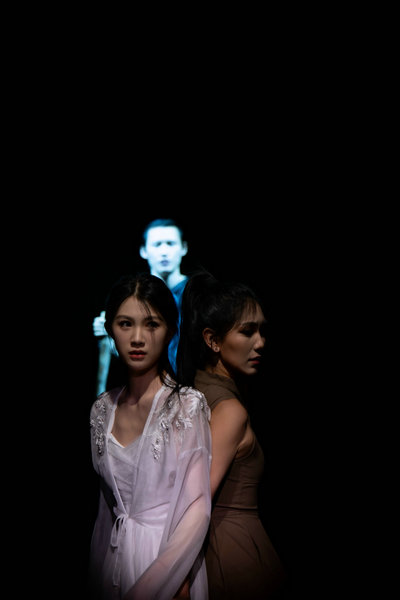
A scene from the premiere of Qingbai: Innocence at Brown University on Dec 1. [Photo provided to chinadaily.com.cn]
The play's title carries a clever double meaning. It refers to Qing and Bai, the two heroines whose destinies are intertwined, and echoes the Chinese word qingbai, meaning "innocence". According to the creators, the production explores the universal theme of self-definition, questioning who gets to judge one's innocence in a world full of prejudice and scrutiny.
"In our version, Bai Suzhen is constantly questioned and scrutinized by Fahai, even pressed to prove her own innocence," says He, noting that Bai's predicament, being forced repeatedly to justify herself, is in fact very common within a broader cultural context.
"What we are concerned with is not whether Bai Suzhen is innocent, but this: when a person is constantly interrogated, suspected and required to justify themselves, how do they gradually come to understand themselves and even choose anew who they want to become?"
Despite being staged in the US, the production was performed entirely in Mandarin, with carefully crafted English subtitles.
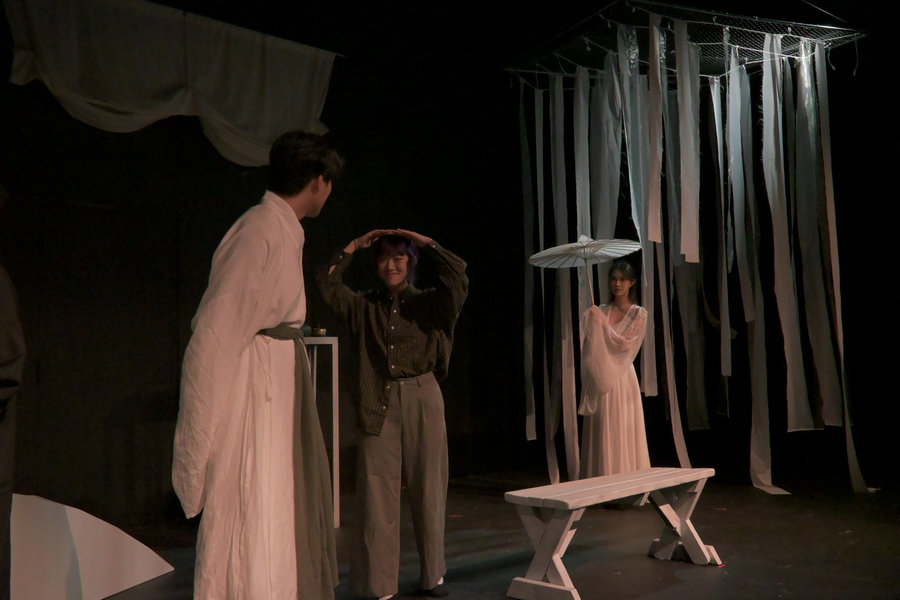
A scene from the performance of Qingbai: Innocence at Brown University in Providence, Rhode Island, on Dec 6. [Photo provided to chinadaily.com.cn]
"Of course, we were aware of the potential language barrier, but we ultimately chose Mandarin because we wanted to preserve the story's original temperament as much as possible," He explains.
"The tonal qualities, rhythm and pauses of Mandarin align especially well with a narrative like The Legend of the White Snake, which carries a strong sense of myth, poetry and musicality.
"For the actors, the language helps us enter the characters more intuitively; for the audience, it creates an atmospheric experience distinct from English."
The playwright and actor says many audience members in the US were able to follow the plot and connect with the characters through the cast's physical expressions alone.
Moving beyond traditional dialogue-driven theater, the creators adopted physical theater techniques, using body movement, breathing rhythms and spatial dynamics to convey emotion and conflict.
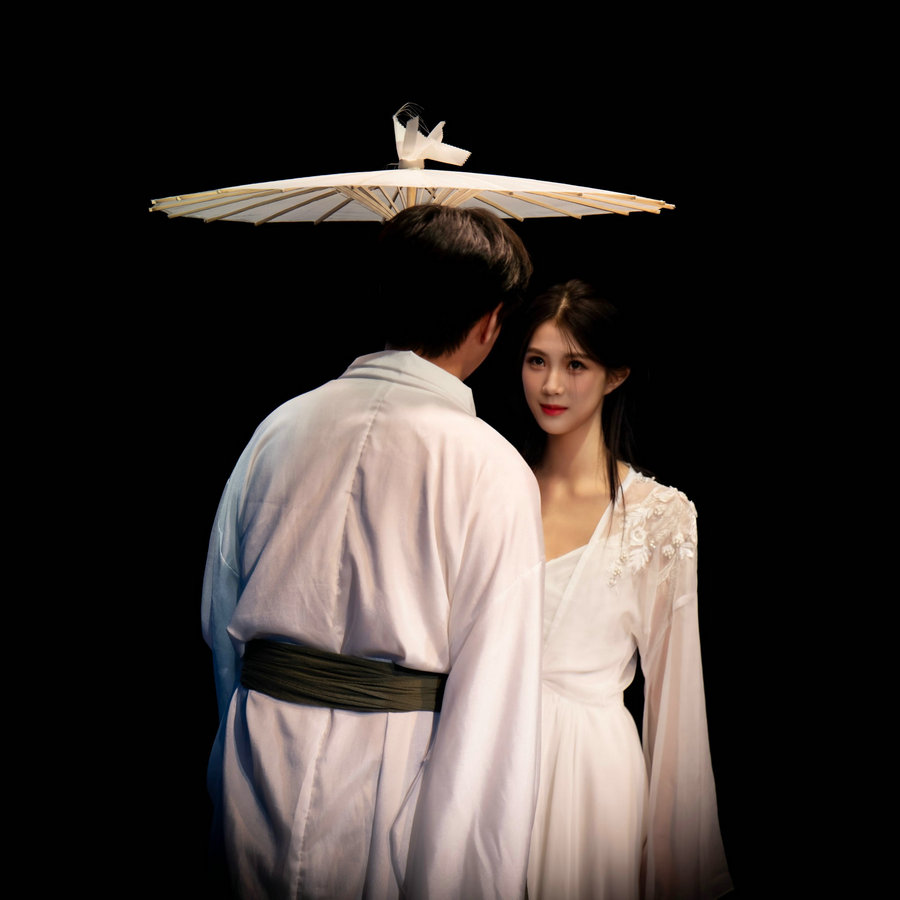
A scene from Qingbai: Innocence, performed at Brown University on Dec 6. [Photo provided to chinadaily.com.cn]
"Through these techniques, our goal is not simply to retell a classic story, but to focus on the emotional and psychological relationships that truly drive it, such as fear, desire, attraction and division," He adds.
"In doing so, we want to make this ancient legend more accessible to contemporary, cross-cultural audiences."
This distinctive approach helped break down language barriers, even for English-speaking viewers with no prior knowledge of the folk tale.
"An American friend of mine, who knew nothing about Chinese culture or the original story, told me she was deeply moved, perhaps for the first time, by an ancient Chinese legend," He recalls.
"She even said she wanted to visit West Lake in Hangzhou, the story's setting, to better understand the culture behind it. Feedback like this means so much to me because it shows that, for a story to resonate with a foreign audience, language itself may not matter as much as emotional power."

A scene from the performance of Qingbai: Innocence at Brown University on Dec 6 features He Chuning as Bai Suzhen, Xu Meimei as Xiaoqing, and Liu Zhiyi, another student at Rhode Island School of Design, as Fahai. [Photo provided to chinadaily.com.cn]
He admits the production faced significant challenges, including a tight schedule and the need to adapt to different theater spaces in each city. The team rebuilt the stage setup for every venue, adjusting lighting, sound and choreography to fit new environments. Meanwhile, as a senior double majoring in computer science and art history, He juggled rehearsals and performances with her academic workload, including two graduation theses.
"Touring three cities required enormous communication and adaptability," she says, "but it also allowed the work to keep growing on different stages."
"The tour's success didn't belong to just a few individuals. It was the result of collaboration among more than 100 participants across multiple schools, disciplines and regions over the past few months."
Hailing from Shenzhen, Guangdong province, the Yale student has a long-standing interest in performance. She has been involved with Yale University's Vermillion Theater as an actor since her freshman year. This past summer, she made her TV drama debut in Rend Night, Regain Light, after which she received more systematic acting training in Beijing.

A scene from the performance of Qingbai: Innocence at HERE Arts Center in New York City on Dec 12. [Photo provided to chinadaily.com.cn]
"During my years of studying abroad, I've become increasingly aware that the emotions and life experiences expressed in many traditional Chinese stories are deeply universal," He says.
"The more I find myself in a cross-cultural environment, the more strongly I feel their power."
Calling The Legend of the White Snake one of her all-time favorite stories, He notes that its repeated retellings speak to shared human experiences, including romantic love obstructed by external forces, hesitation between drawing closer and pulling away, and the tendency to retreat when faced with difficult choices.
"These themes are universal," she emphasizes. "That's why, even in an overseas context, this story continues to resonate emotionally across cultures."
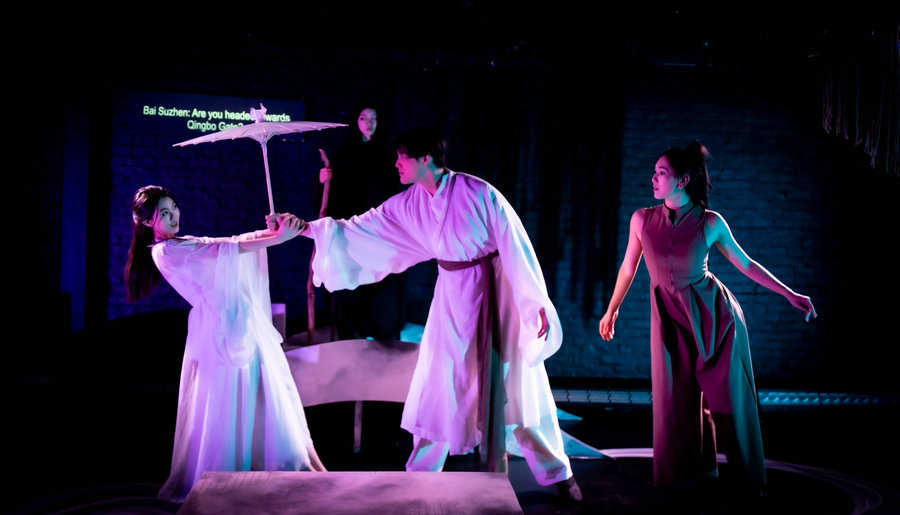
A scene from the performance of Qingbai: Innocence at HERE Arts Center in New York City on Dec 12 features He Chuning as Bai Suzhen, Tara P. Nyingjè as Xiaoqing, Huang Yuwei as Xu Xian, and Chang Jinxian, a drama student at New York University, as Fahai. [Photo provided to chinadaily.com.cn]
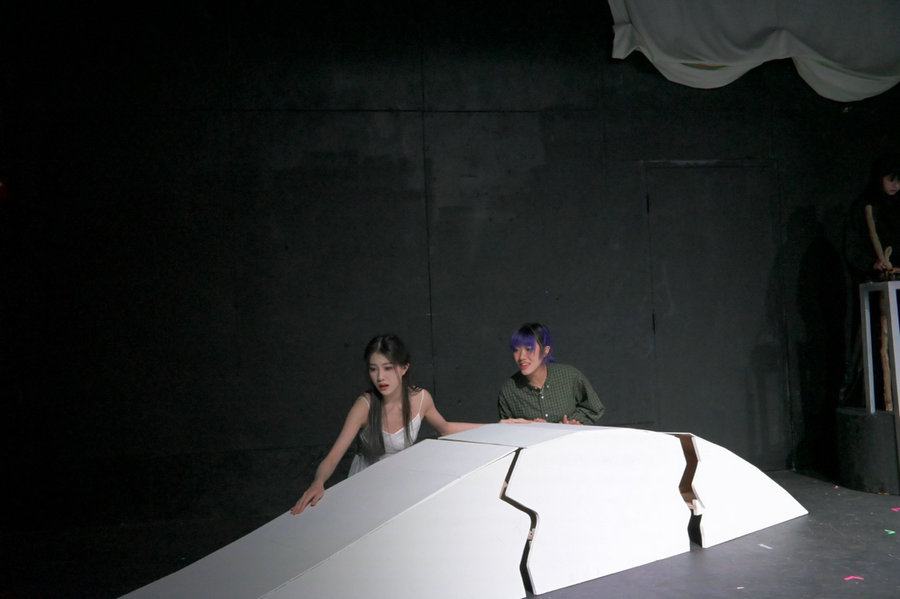
A scene from the performance of Qingbai: Innocence at Brown University on Dec 6 features He Chuning as Bai Suzhen and Xu Meimei, a student at Rhode Island School of Desig as Xiaoqing. [Photo provided to chinadaily.com.cn]
 Editor:Cai Xiaohui

